
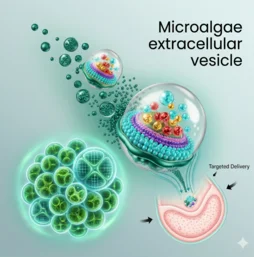
What Are Microalgae-Derived Extracellular Vesicles?
Definitions, Source Considerations and Analytical Boundaries
Extracellular vesicles (EVs) are membrane-delimited particles naturally released by cells. Microalgae can release nanoscale extracellular particles into conditioned culture media, and published studies have characterized microalgae-derived EV preparations using microscopy, nanoparticle tracking analysis, and complementary biochemical methods.

Extracellular Vesicles as Biological Particles
Extracellular vesicles (EVs) are membrane-delimited particles naturally released by cells. They may carry lipids, proteins, nucleic acids, and other components from the source cell, but their composition varies with the organism, culture conditions, isolation method, and analytical workflow.

EVs, Exosomes and Operational Terminology
EV is the preferred general term when the biogenesis of a vesicle population has not been demonstrated. The term exosome refers to a specific endosomal biogenesis pathway and should not be assigned solely from particle size. For commercial and technical communication, source, size range, analytical method, and preparation type should be stated explicitly.

Particle Characterization
Nanoparticle tracking analysis (NTA) can estimate particle-size distribution and particle concentration under defined measurement conditions. NTA does not by itself confirm vesicle identity, purity, molecular cargo, biological activity, skin penetration, or finished-product efficacy.
Composition and Formulation Evaluation
Microalgae-derived EV preparations may be evaluated as non-animal biological materials for research and cosmetic formulation. Product identity, residual components, compatibility, stability, safety, storage, and market-specific requirements should be reviewed for the selected commercial grade.
The terms extracellular vesicle and exosome are not interchangeable. Exosome describes a vesicle subtype associated with a defined endosomal biogenesis pathway. When subtype origin has not been established, extracellular vesicle, small EV, or an operational description based on source and analytical characteristics is more appropriate.
Analytical results should be interpreted method by method. Particle size and concentration are useful quality attributes, but they do not alone establish purity, cargo, mechanism, biological performance, skin penetration, or clinical efficacy. Formulators should review the complete product specification and test the final formulation.
Key Evaluation Points
- Source organism, culture conditions, and traceability
- Collection from conditioned medium and separation workflow
- Particle-size and particle-concentration methods and acceptance criteria
- Identity, purity, residuals, microbiological quality, and batch documentation
- Liquid or powder format, compatibility, stability, storage, and cold-chain requirements
- Final-formulation safety assessment, claims, and destination-market compliance
Evidence Boundary
Microscopy, NTA, biochemical analysis, and cell-based assays provide different types of evidence. No single method independently demonstrates vesicle subtype, skin delivery, tissue repair, regeneration, or finished-product performance.
Related Pages
Review FEBICO CSEV product formats and commercial specifications
Explore microalgae process development and scale-up capabilities
Source Reference
- Théry C, et al. Minimal information for studies of extracellular vesicles 2018 (MISEV2018). Journal of Extracellular Vesicles. https://doi.org/10.1080/20013078.2018.1535750
- Welsh JA, et al. Minimal information for studies of extracellular vesicles (MISEV2023). Journal of Extracellular Vesicles. https://doi.org/10.1002/jev2.12404
- Picciotto S, et al. Isolation of extracellular vesicles from microalgae: towards the production of sustainable and natural nanocarriers of bioactive compounds. Biomaterials Science. https://doi.org/10.1039/D0BM01696A
- Adamo G, et al. Nanoalgosomes: introducing extracellular vesicles produced by microalgae. Journal of Extracellular Vesicles. https://doi.org/10.1002/jev2.12081
- Related Product
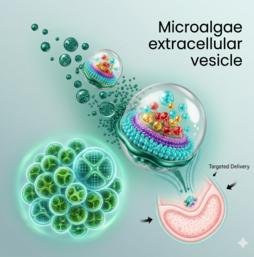
Chlorella Sorokiniana Extracellular Vesicles
FEBICO Chlorella Sorokiniana Extracellular Vesicles (CSEV) are an extracellular-vesicle-enriched ingredient derived from Chlorella sorokiniana culture...
Details